
Case Study
How DealerEdge Called the VRT S&P 500 Trade Before the Announcement
On March 6, 2026, we bought VRT 260 calls at 3:53 PM. At 5:15 PM, Vertiv was officially confirmed as an S&P 500 addition. The trade wasn't a guess — DealerEdge showed $260 as the GEX anchor with a 5/5 rating and Long Gamma bias. Here's the full breakdown.
Summary Stats
- Ticker: VRT (Vertiv Holdings)
- Instrument: 260 calls, 03/13 expiration
- Entry: $5.15
- Contracts: 20
- Entry time: 3:53 PM ET — 82 minutes before the S&P 500 announcement
- Edge used: DealerEdge GEX + S&P 500 rebalance thesis
The Context: S&P 500 Quarterly Rebalance
Every quarter, the S&P 500 index committee announces which stocks are being added and removed. The announcement comes after the market close — typically at 5:15 PM ET on the first Friday of March, June, September, and December.
When a stock gets added, every index fund tracking the S&P 500 is forced to buy shares. That's roughly $7.8 trillion in assets that must rebalance. JPMorgan estimated approximately $28.8 billion in total rebalance trading around this event.
On March 6, 2026, Vertiv was one of the top candidates. A $95 billion data center infrastructure company that wasn't in the index yet — the kind of name that checks every eligibility box.
But we didn't trade the thesis alone. We traded the positioning.
The Setup: What DealerEdge Showed
Before entering the trade, DealerEdge showed a textbook bullish setup on VRT:
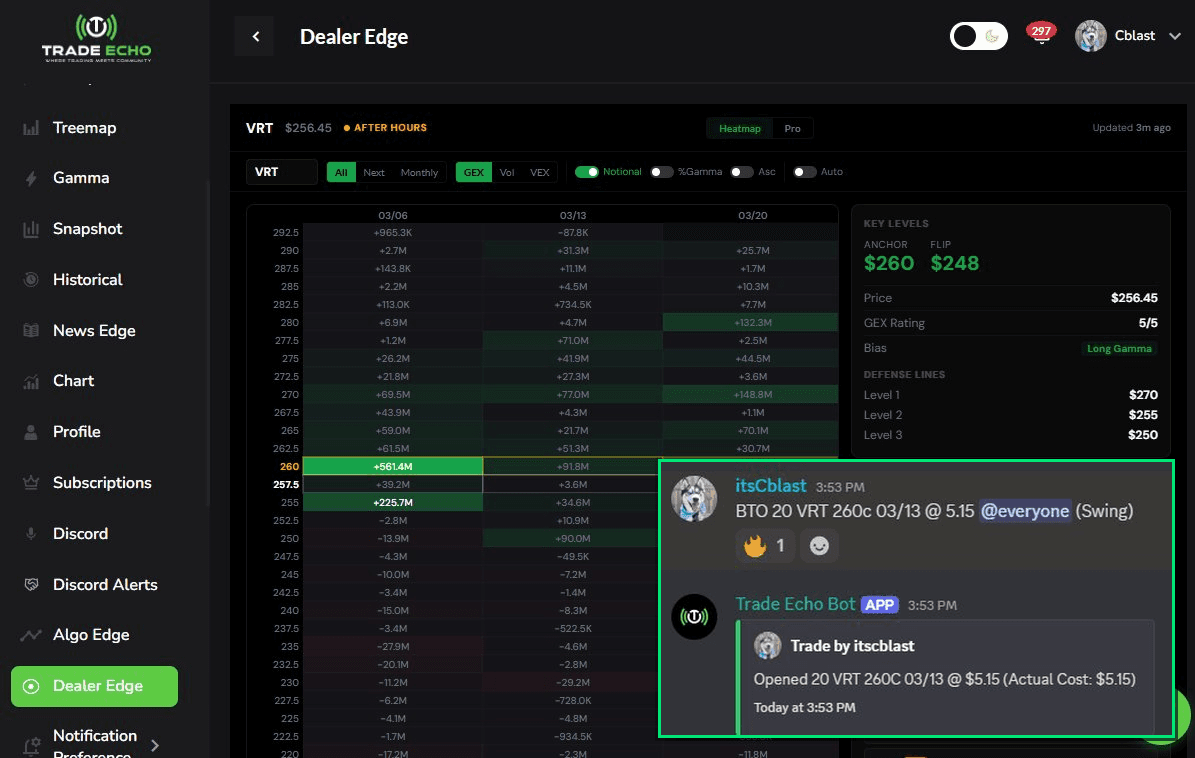
- Anchor Point: $260 — the strike with the highest gamma concentration. This was the price magnet. The 260 strike showed +$561.4M in GEX for the 03/06 expiration alone.
- GEX Flip Point: $248 — well below the current price of $256.45, confirming VRT was trading in positive gamma territory.
- GEX Rating: 5/5 — maximum bullish dealer positioning. Market makers were firmly positioned for calls.
- Bias: Long Gamma — dealers would be buying dips and supporting price, not amplifying sell-offs.
- Defense Lines: $270 (Level 1), $255 (Level 2), $250 (Level 3) — multiple layers of support below.
Translation: price at $256.45 was sitting below the $260 anchor in positive gamma territory with maximum bullish dealer positioning. That's three out of three conditions for a price pinning setup — the highest-probability configuration in GEX analysis.
Reading the GEX Heatmap
The DealerEdge heatmap told the story visually. The 260 strike was lit up bright green across multiple expirations — +$561.4M on 03/06, +$91.8M on 03/13, and +$319.6M on 03/20. That level of gamma concentration across expirations creates powerful magnetic pull.
Below 260, the 255 strike also showed heavy positive gamma at +$225.7M, giving the trade a support floor. Above 260, gamma remained positive through 270 before tapering off — meaning the path to and through the anchor was paved with supportive dealer hedging flows.
When you see this kind of gamma stacking at one strike across multiple timeframes, price doesn't just visit that level — it gets pinned there.
The Catalyst Layer: Index Inclusion Thesis
DealerEdge gave us the level. The S&P 500 rebalance thesis gave us the catalyst.
Earlier that day, we published the top candidates for S&P 500 inclusion with estimated odds. VRT was listed at 65% probability based on Stephens analyst coverage, Polymarket prediction markets, and the company's $95B market cap — making it one of the largest eligible companies not yet in the index.
Two signals pointing the same direction: dealer positioning (bullish at 260) + macro catalyst (forced index fund buying if confirmed). That's confluence.
The Trade: Step by Step
- Pre-trade analysis: DealerEdge shows anchor $260, GEX 5/5, Long Gamma bias, flip at $248. Price at $256.45 — below anchor, above flip. All conditions met for a bullish pinning setup.
- Catalyst identified: S&P 500 rebalance announcement due at 5:15 PM ET. VRT among the top candidates. If confirmed, forced buying from $7.8T in index funds.
- Entry: BTO 20 VRT 260c 03/13 @ $5.15 at 3:53 PM ET. Strike selected at the anchor level. 03/13 expiration gives over a week for the trade to work — the S&P 500 changes typically take effect on the third Monday of the month (March 23), meaning the position captures the announcement pop and the lead-up to actual index inclusion.
- Risk management: $255 Defense Line as the invalidation level. Below that, the gamma support structure weakens. Position sized at 20 contracts — defined risk, clear stop.
- 5:15 PM ET: S&P Dow Jones Indices confirms Vertiv is being added to the S&P 500, effective prior to the open on March 23, 2026.
Why This Worked: The Framework
This wasn't one signal. It was a stack of signals all pointing at the same strike:
- DealerEdge identified the level — $260 anchor with +$561M in gamma and a 5/5 rating gave us the exact strike and directional bias before the announcement.
- GEX structure confirmed the bias — Long Gamma, price below anchor, above flip. The textbook pinning setup said: lean bullish, target the anchor.
- The macro catalyst aligned — S&P 500 inclusion creates mechanical buying pressure. Not opinion-based — fund managers have no choice but to buy.
- Expiration was strategic — 03/13 captures the announcement reaction and the run-up to the March 23 effective date when index funds actually rebalance.
The process: Level first. Bias second. Catalyst third. Execution fourth.
What Made This Different From Guessing
Plenty of people speculated on VRT getting added to the S&P 500. What separates speculation from a trade plan is having a defined level, a defined bias, and a defined invalidation.
Without DealerEdge, you might have bought VRT calls at any strike — 250, 260, 270 — based on gut feeling. With DealerEdge, the $260 anchor told you exactly where gamma was concentrated. The 5/5 GEX Rating told you the direction. The $255 Defense Line told you where the thesis breaks.
That's the difference between trading with data and trading with hope.
What You Can Learn From This Trade
You don't need S&P 500 inclusion events to use this framework. The lesson is the process:
- Check DealerEdge before you trade. Know where the anchor is, what the GEX rating says, and where the flip point sits. This takes 60 seconds.
- Look for the pinning setup. Price below anchor + high GEX rating + above flip point = highest probability configuration. When all three align, lean into it.
- Select your strike at the anchor. The anchor is where gamma is heaviest. That's your target and often your best strike selection.
- Add catalysts as confirmation, not conviction. DealerEdge gives the level. News, events, and macro give the reason price gets there. Don't reverse the order.
- Use Defense Lines for risk management. The $255 and $250 Defense Lines gave clear invalidation levels. If those break, the gamma support structure changes and the thesis weakens.
Try This Framework Yourself
The same DealerEdge data that identified the VRT setup runs on every optionable ticker — SPX, QQQ, AAPL, NVDA, TSLA, and hundreds more. Every session, check the anchor, the rating, and the flip point. In 60 seconds, you'll have a directional bias backed by dealer positioning — not headlines, not guesswork.
Start using DealerEdge with Trade Echo — $199/mo
Disclaimer
Single trade example shared for educational purposes only. Results are not typical and are not a guarantee of future performance. Options involve substantial risk and are not suitable for every investor. Past performance does not guarantee future results. Trade Echo provides analytics and alerts; it does not provide financial advice or recommendations.