
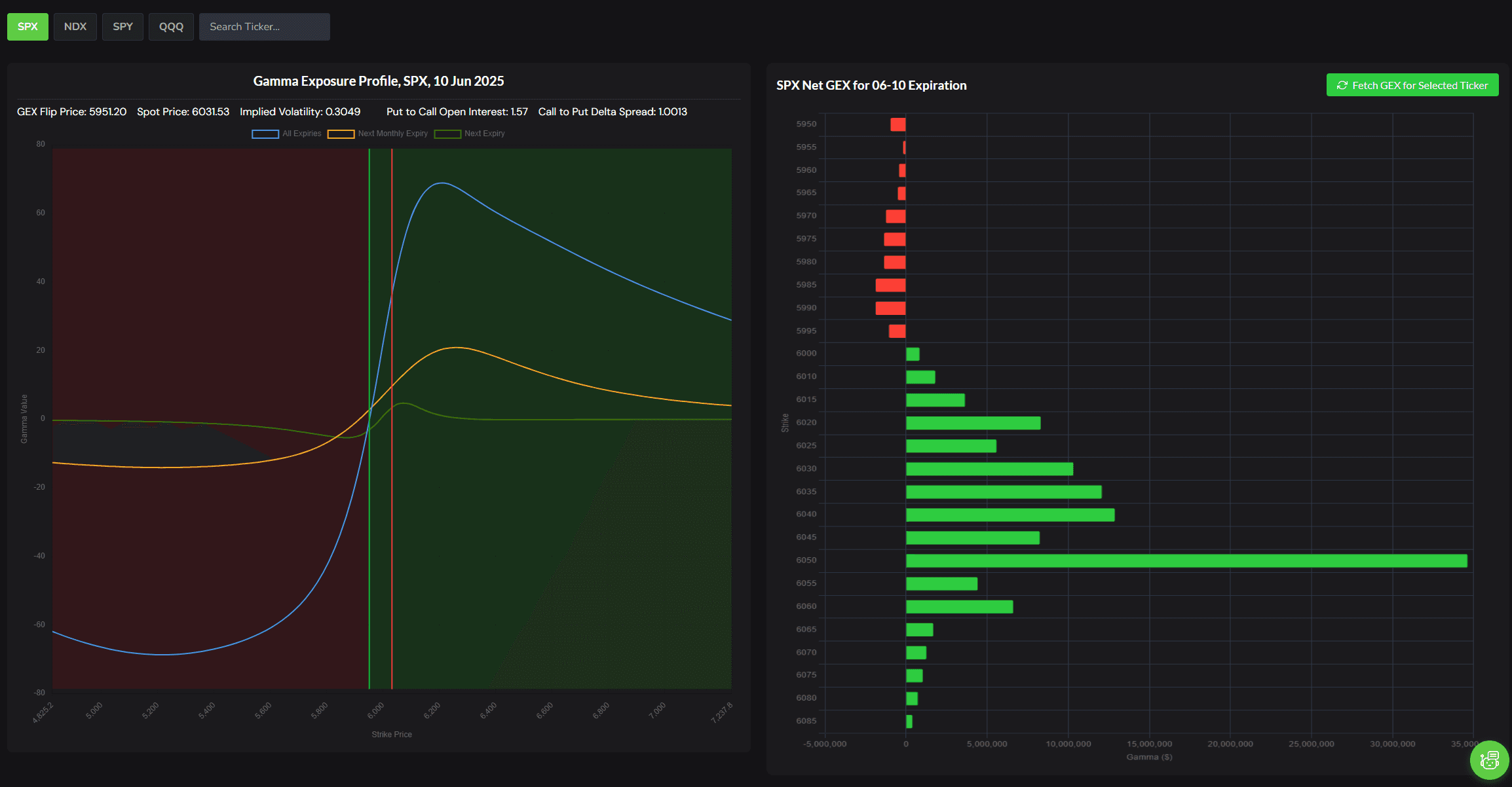
The Gamma Module helps traders analyze gamma exposure (GEX) for the S&P 500 (SPX), revealing how market makers’ hedging affects price movements. This guide summarizes how to use it for trading, especially with zero days to expiration (0DTE) options.
What Is Gamma Exposure?
Gamma exposure (GEX) measures how an option’s delta changes with the SPX price, showing market makers’ hedging impact. Positive GEX (long gamma) stabilizes prices as makers buy dips and sell rallies. Negative GEX (short gamma) amplifies volatility, with makers buying rallies and selling dips. The GEX flip price, where gamma shifts from positive to negative, often acts as support or resistance.
Navigating the Gamma Module
The Gamma Module displays a GEX profile, charting net GEX across SPX price levels. Key metrics include:
- GEX Flip Price: Where net gamma shifts; a key support/resistance level.
- Spot Price: Current SPX price, indicating positive or negative gamma.
- Implied Volatility: Affects option premiums and expected price swings.
- Put to Call Open Interest: Ratio showing bullish or bearish sentiment.
- Call to Put Delta Spread: Balances delta exposure between calls and puts.
- GEX Peaks: Highest GEX levels, acting as price magnets.
The chart highlights the flip price and spot, helping traders visualize hedging dynamics. For 0DTE options, gamma peaks near at-the-money strikes, amplifying price sensitivity.
Using the GEX Profile
The GEX profile shows net GEX in billions per 1% SPX move. If the spot price is above the flip price, positive GEX suggests lower volatility and price stability. Below the flip price, negative GEX may increase volatility. For example:
| SPX Level Net GEX ($B) Implication | ||
| Below Flip -2 | Volatility increases; price swings likely. | |
| At Flip 0 | Neutral; potential support/resistance. | |
| Above Flip +3 | Stable prices; hedging dampens moves. |
High put-to-call ratios suggest bearish sentiment, while balanced delta spreads require context to interpret.
Trading with 0DTE Options
0DTE options have high gamma, making them ideal for short-term trades but risky due to rapid delta changes. Strategies include:
- Support/Resistance: Trade bounces near the flip price, where hedging creates support.
- Volatility Plays: Sell options in positive GEX for low volatility; buy in negative GEX for swings.
- Scalping: Target at-the-money strikes for quick profits on small price moves.
Tip: Combine GEX with technical indicators to confirm entries and exits.
Getting Started
Access the Gamma Module and review the GEX profile. Focus on the flip price and spot peaks to identify key levels. For 0DTE trading, target at-the-money strikes and monitor price moves relative to the flip price. Start with small positions, track results, and refine your strategy with real-time GEX updates.
Practical Tips
- Set alerts for price moves near the flip price to catch potential reversals.
- Use high gamma in 0DTE options for quick trades, but manage risk tightly.
- Cross-reference GEX with option flow or volatility data for better decisions.